2026-09-09 ·
Dental Implants vs Dental Bridge: Cost Over Ten Years
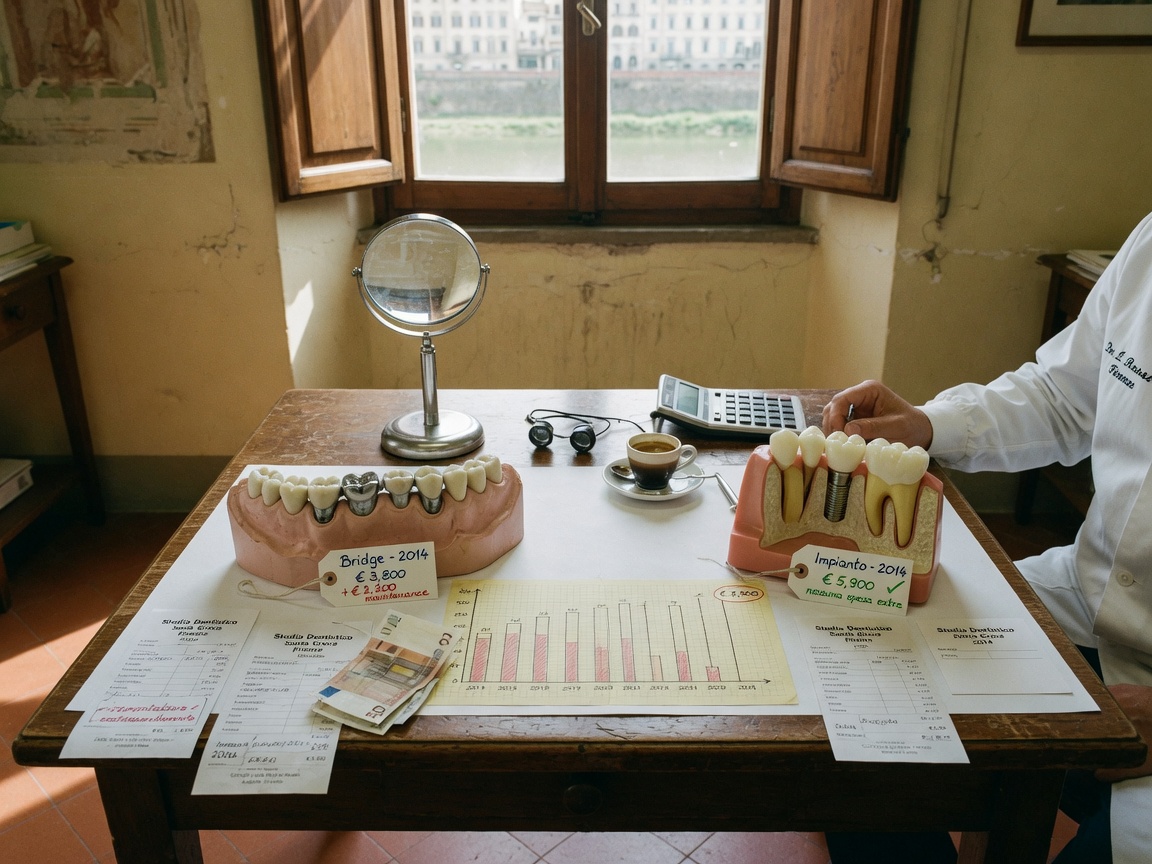
A dental implant costs more on day one and less over ten years. A single implant in Florence runs $3,000 to $5,000 and is still in place at ten years in 90 to 95 percent of cases. A three-unit bridge runs $2,500 to $5,000 and is replaced at seven to fifteen years, so most patients buy it twice inside the same decade. Add the second bridge and the two routes cross somewhere around year nine. What the ten-year figure still leaves out is the damage a bridge does to the two teeth holding it up, which is where the real cost sits.
What does each option cost up front?
A single implant is $3,000 to $5,000, split into $1,800 to $2,500 for surgical placement under CDT code D6010, $400 to $700 for the abutment under D6057, and $1,200 to $2,000 for the crown under D6058. A traditional three-unit bridge is $2,500 to $5,000, covering two crowns on the adjacent teeth and one suspended pontic between them. An implant-supported bridge, which uses two implants and touches no natural teeth, is $6,000 to $10,000 for the same three-tooth span.
What does each cost over ten years?
The implant costs what you paid, plus roughly $600 in hygiene visits and one abutment screw retightening. Call it $4,600 on a $4,000 case. The bridge costs $3,500 up front, a replacement at year eight to twelve at $3,500 to $5,000, and in a meaningful share of cases a root canal on one abutment tooth at $1,000 to $1,500 plus a new crown. A realistic ten-year bridge total lands between $7,000 and $10,000. The implant is cheaper by year nine and considerably cheaper by year fifteen.
What does a bridge do to the teeth either side?
It grinds them down to pegs. A three-unit bridge requires removing 60 to 70 percent of the crown structure from both abutment teeth, and those teeth are frequently healthy before the work starts. Between 4 and 15 percent of them need root canal treatment afterwards because the preparation comes close to the pulp. If either abutment later fails, the whole bridge comes out and you are replacing three teeth instead of one. An implant leaves both neighbours untouched, which is the argument that decides most single-gap cases in Florence regardless of the arithmetic above.
What happens to the bone under each?
Under a bridge, nothing good. The pontic rests on the gum and transmits no load into the ridge beneath it, so the bone keeps resorbing, losing roughly 50 percent of its width in the first year after extraction and continuing slowly after that. Within five years a visible hollow develops under the pontic that traps food and looks obviously artificial. An implant transmits chewing load directly into bone, which is the signal that stops resorption. That difference is also why a patient who chooses a bridge now and wants an implant in eight years usually needs bone grafting first, at $300 to $1,200 added to the eventual cost.
When is a bridge actually the better choice?
Three situations. When the adjacent teeth already need crowns for their own reasons, the bridge is nearly free structurally, because you were cutting those teeth anyway. When bone volume is inadequate and the patient does not want grafting or the six months it adds. And when the cash matters more than the decade, which is a legitimate reason and not one to be argued out of. Bridges are a sound restoration used in the right case. They are just used in the wrong case very often.
How long does each take?
A bridge takes two to three weeks and two appointments. An implant takes four to eight months, because osseointegration runs three to four months in the lower jaw and four to six in the upper. That timeline gap is the honest disadvantage of implants and the reason many patients pick the bridge. Where the gap is visible, same-day dental implants close it with an immediate temporary, so nobody waits with a hole in their smile.
Which should I choose?
For a single gap with healthy neighbours, the implant, on the strength of the two untouched teeth alone. For a gap where both neighbours already need crowns, the bridge. For consecutive gaps, neither: two implants carrying a three-tooth bridge costs less than three separate implants and preserves everything else. A dental implant consultation with a CBCT scan settles which of the three your case is, and gives you an itemised quote you can take elsewhere to compare.